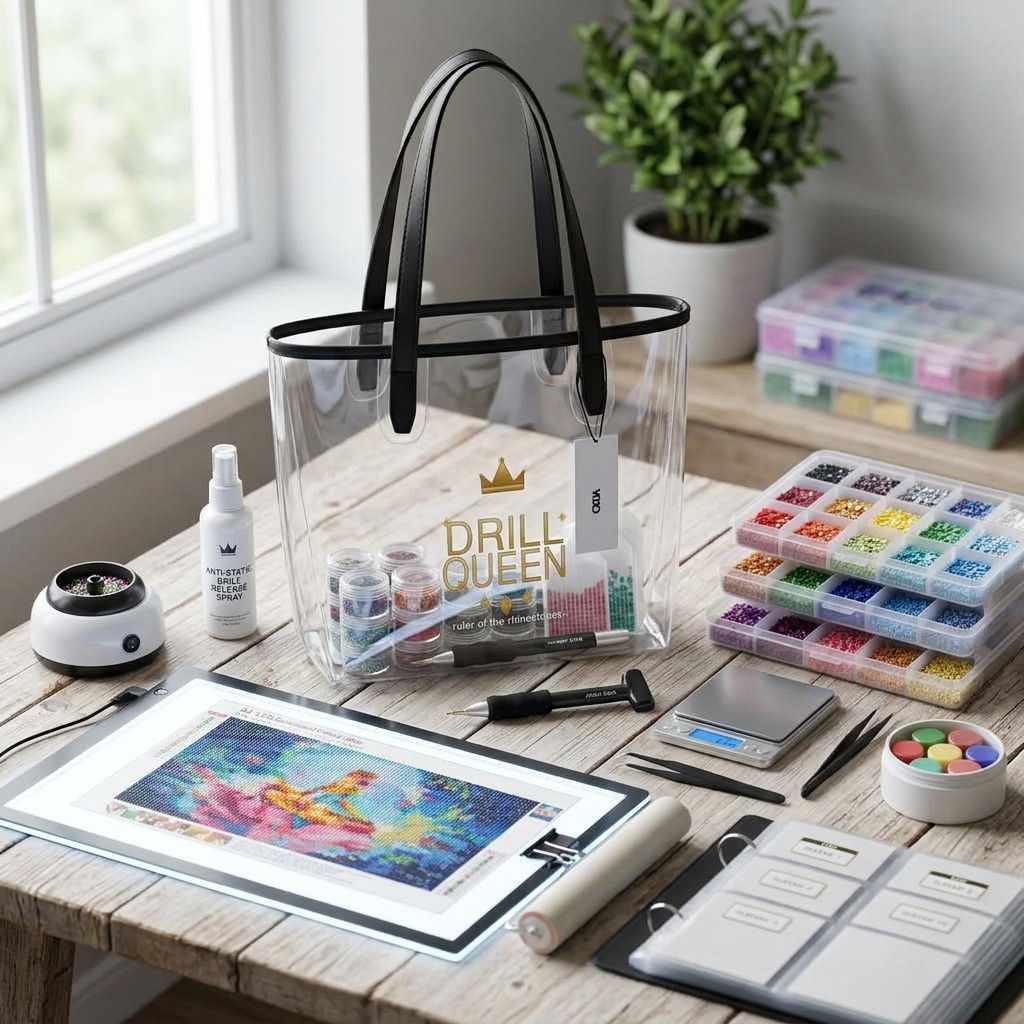
Twelve accessories decide whether a diamond painting session feels relaxing or feels like a scavenger hunt for a missing wax packet. This guide ranks the tools, storage, and finishing gear that actually change how a kit gets stitched in 2026, from the first drill to the last coat of sealant.
- The Tool Keeper Drill Pen & Tool Case is the best diamond painting accessory for long-term tool organization in 2026.
- The Diamond Art Drill Packet Tray solves mid-session color sorting better than a pile of loose bags.
- The Drill Queen Gold Crown Clear Tote passes stadium bag checks and works as a travel case for craft fairs in 2026.
- Mushroom Storage Containers hold loose drills between projects; buy two if you run more than one kit at once.
Why this matters
A diamond painting kit ships with a canvas, drills, a pen, and wax. Everything else, the totes, the trays, the light pads, is what turns a single kit into a repeatable hobby setup. Jeanne Argent stocks several of these accessories directly, and the rest are common enough in the hobby that most crafters already own a version of them.
The ranking below is built around one question for each item: what specific problem does it solve, and what does it fail to solve. That framing matters more here than in most buying guides, because diamond painting accessories are cheap enough that people buy several at once without checking whether two of them do the same job.
What makes the best diamond painting accessories
- Solves one problem completely rather than half-solving three
- Survives repeated handling across multiple kits, not just one project
- Fits an existing setup instead of forcing a new storage system
- Portable when it needs to be, flat and stackable when it does not
- Made for actual drill sizes and canvas dimensions used in current kits (most run 40x50cm or larger in 2026)
- Clear purpose in the pros/cons, not a vague "nice to have"
Diamond painting accessories at a glance
| # | Item | Best for | Standout feature | Key limitation |
|---|---|---|---|---|
| 1 | Tool Keeper Drill Pen & Tool Case | Long-term tool organization | Dedicated slots for pens, tips, and spares | Not built for canvas storage |
| 2 | Drill Packet Tray (12-Slot) | Mid-session color sorting | Tilted slots keep packets visible at a glance | Only 12 slots per tray |
| 3 | Light pad | Low-light stitching accuracy | Back-lit grid makes faint lines readable | One more device to charge |
| 4 | Wax or tack pad | Keeping drills seated on the stylus | Tackier hold than kit-included wax | Needs replacing every few kits |
| 5 | Multi-placer pen | Speed on large canvases | Picks up several drills per press | Steeper learning curve |
| 6 | Mushroom Storage Containers | Loose drill and bead storage between projects | Screw-top lid stops spills mid-move | Small capacity per jar |
| 7 | Clear Tote (Drill Queen Gold Crown) | Travel and stadium events | See-through design clears venue bag checks | Not padded for canvases |
| 8 | Canvas storage tube | Protecting unfinished canvases | Rolls canvas without creasing the pattern | Takes up closet space |
| 9 | Sealing roller | Pressing finished sections flat | Even pressure without smearing wax | Manual work on large pieces |
| 10 | No-wrinkle frame or stand | Keeping large canvas taut | Reduces sag on 40x50cm+ pieces | Extra setup per session |
| 11 | Craft lap desk or easel | Ergonomic long sessions | Tilts canvas to reduce neck strain | Bulkier to store flat |
| 12 | Finishing sealant spray | Protecting a completed canvas before framing | Locks drills in place against dust | Needs ventilation while drying |
1. The Tool Keeper Drill Pen & Tool Case: best diamond painting accessory for long-term organization
The Tool Keeper is a dedicated case built to hold a diamond painting pen, spare tips, tweezers, and the small parts that otherwise migrate into random drawers. It is the kind of accessory that stops mattering after the first kit and starts mattering by the fifth, once a crafter owns three pen tips and two wax pots with nowhere fixed to live.
Tool Keeper pros:
- Keeps pen, tips, and spares in one closed case instead of scattered across a table
- Structured slots mean less digging mid-session
- Reusable across every future kit, not tied to one canvas
Tool Keeper cons:
- Does not store canvases or finished pieces
- Overkill if a crafter owns just one pen and no spares
Tool Keeper pricing: listed directly on the product page; check current details before ordering.
Best for: crafters who run more than one kit a year and are tired of hunting for the right pen tip. Verdict: Buy.
2. Diamond Art Drill Packet Tray (12-Slot): best for mid-session color sorting
This tray tilts twelve drill packets at an angle so every color is visible without lifting a single packet. It targets the exact moment a crafter knows the right shade is somewhere in the pile and has already spent several minutes checking the wrong ones.
Drill Packet Tray pros:
- Tilted slots show color and code at a glance
- Keeps opened packets from spilling mid-session
- Compact enough to sit next to the canvas
Drill Packet Tray cons:
- 12 slots run short on kits with 20+ colors, so larger canvases need two trays
- Not built for long-term storage between projects
Best for: active stitching sessions on kits with a moderate color count. Verdict: Buy.
3. Light pad: best for low-light stitching accuracy
A back-lit pad under the canvas makes faint printed grid lines readable well after sunset, which matters more than most new crafters expect. Cheaper canvases especially benefit, since the printed symbols fade fastest under regular room lighting.
Light pad pros:
- Makes faded or light-printed canvases readable again
- Useful for any close needlework, not just diamond painting
- Battery or USB models both exist depending on setup
Light pad cons:
- One more device to charge or keep plugged in
- Glare can be an issue on glossy canvases
Best for: evening sessions and older or lighter-print canvases. Verdict: Buy if stitching after dark; Skip if daylight-only.
4. Wax or tack pad: best for keeping drills seated on the stylus
Every kit ships with a small wax square, and every regular crafter eventually needs more. A dedicated tack pad holds a stickier, longer-lasting formula than most included wax, which matters most on humid days when kit wax turns slick.
Wax pad pros:
- Stronger grip than most stock kit wax
- Cheap to replace
- Small enough to travel in any tool case
Wax pad cons:
- Wears down and needs replacing every few kits
- Not a fix for a worn-out pen tip
Best for: anyone who has dropped a drill mid-placement more than once. Verdict: Buy.
5. Multi-placer pen: best for speed on large canvases
A multi-placer pen lifts several drills at once instead of one per press, which cuts real time off large 40x50cm or bigger canvases. It trades precision for speed, so it suits open background areas better than tight detail sections.
Multi-placer pros:
- Noticeably faster on large solid-color fields
- Reduces hand fatigue over long sessions
Multi-placer cons:
- Slower to learn than a standard single-drill pen
- Less accurate near fine detail or edges
Best for: crafters working large-format canvases who want background fills done faster. Verdict: Buy for large canvases; Skip for detail-heavy small kits.
6. Mushroom Storage Containers: best for loose drill and bead storage between projects
These screw-top jars are built for exactly the small-object problem every diamond painter runs into: loose drills, spare beads, or leftover packets with nowhere sealed to sit. The screw lid means a jar can be tipped in a bag without spilling, unlike a snap-top container.
Mushroom Storage Containers pros:
- Screw-top lid seals fully, unlike snap-lid alternatives
- Small footprint stacks easily in a drawer or bin
- Useful beyond diamond painting for any small craft parts
Mushroom Storage Containers cons:
- Capacity per jar is limited, so a full kit's leftovers need two or three
- Not designed to hold an entire unfinished project
Best for: storing the leftover drills every finished kit generates. Verdict: Buy.
7. Diamond Painting Clear Tote (Drill Queen Gold Crown): best for travel and stadium events
A see-through tote solves a problem specific to taking a project out of the house: venue bag checks. Stadiums, arenas, and some craft fairs require clear bags, and a standard tote or backpack gets turned away at the door.
Clear Tote pros:
- Clears stadium and venue bag-check policies
- Enough room for a rolled canvas, drill packets, pen, and wax
- Doubles as an everyday project bag at home
Clear Tote cons:
- Not padded, so canvases should travel flat rather than folded
- Clear design means the mess inside is visible too
Best for: crafters who take projects to events with clear-bag rules. Verdict: Buy.
8. Canvas storage tube: best for protecting unfinished canvases
A rigid tube keeps a partially finished canvas rolled without creasing the printed pattern or knocking loose drills off placed sections. This matters most for anyone who works on one project across several weeks and needs it to survive being put away and pulled back out.
Canvas tube pros:
- Prevents creasing that a folded canvas develops over time
- Keeps drills already placed from shifting
Canvas tube cons:
- Takes up more closet or shelf space than a flat folder
- Awkward for very large or very small canvases alike
Best for: long-running projects that get stored between sessions. Verdict: Buy if a project runs longer than a weekend.
9. Sealing roller: best for pressing finished sections flat
A roller applies even pressure across a completed section, seating every drill firmly without smearing the wax residue a hand press tends to leave behind. It is a small step that noticeably changes how a finished canvas looks under light.
Sealing roller pros:
- Even pressure across the whole section
- Faster than pressing drill by drill with a fingertip
Sealing roller cons:
- Manual effort scales with canvas size
- Adds a step most beginners skip entirely
Best for: crafters finishing a canvas they plan to frame or gift. Verdict: Buy.
10. No-wrinkle frame or stand: best for keeping large canvas taut
Larger canvases, especially at 40x50cm and up, sag in the middle without support, which throws off drill alignment near the center. A frame or stand holds the fabric taut the way an embroidery hoop does for cross-stitch.
No-wrinkle frame pros:
- Keeps large canvases flat and aligned while working
- Reduces the drift that causes crooked rows
No-wrinkle frame cons:
- Extra setup time before each session
- Not necessary on smaller canvases
Best for: large-format kits worked over multiple sittings. Verdict: Buy for large kits; Skip for small ones.
11. Craft lap desk or easel: best for ergonomic long sessions
A tilted lap desk or easel angles the canvas up toward the crafter instead of flat on a table, cutting the neck strain that comes with hours spent looking straight down. This is the accessory long-session crafters mention wishing they had bought sooner.
Lap desk pros:
- Reduces neck and back strain on long sessions
- Works on a couch, bed, or table equally well
Lap desk cons:
- Bulkier to store than a flat surface
- Unnecessary for short, occasional sessions
Best for: anyone stitching for more than an hour at a stretch. Verdict: Buy if sessions run long; Wait if sessions are short.
12. Finishing sealant spray: best for protecting a completed canvas before framing
A sealant spray locks finished drills against dust, shifting, and minor bumps once a canvas is done, which matters most for pieces headed for framing or gifting. It is the last step, not an early-project accessory, and skipping it is fine for canvases that will sit under glass anyway.
Sealant spray pros:
- Locks drills in place against dust and shifting
- Adds a light protective finish before framing
Sealant spray cons:
- Needs ventilation and drying time
- Not needed if the canvas goes straight under glass
Best for: finished canvases being displayed unframed. Verdict: Buy if displaying unframed; Skip if framing under glass.


“If a drill keeps sliding off the stylus tip, the pen is not the problem, the wax is.”
How this list was ranked
Each accessory earned a spot by solving one specific step in the diamond painting process: sorting, seating, storing, transporting, or finishing. Items that duplicated another entry's job, a second style of tote, a second sorting tray, were left out even when they exist, because the goal here is a decision tree, not a leaderboard of similar products.
Which diamond painting accessories should you choose?
Start with the Tool Keeper Drill Pen & Tool Case and a Drill Packet Tray if organization is the current pain point in 2026. Add a Clear Tote once trips to craft fairs or events with bag-check rules start happening regularly. Mushroom Storage Containers close the loop for leftover drills once the second or third kit is underway, and the rest, the light pad, the wax, the roller, the frame, get added as specific friction points show up rather than bought all at once.
FAQ
What is the best diamond painting accessory to buy first?
A dedicated tool case like the Tool Keeper is the best first diamond painting accessory in 2026 because it solves the organization problem every ongoing hobbyist eventually hits. A drill packet tray is a close second for anyone already mid-kit.
Do I need a light pad for diamond painting?
A light pad is only necessary for evening sessions or canvases with faint printed lines. Daylight stitchers on newer, well-printed canvases can skip it entirely.
Is a clear tote better than a regular craft bag?
A clear tote is better specifically for venues with bag-check policies, since standard totes and backpacks get turned away at stadiums and some craft fairs. For home use only, a regular bag works just as well.
How should I store leftover diamond painting drills?
Screw-top containers like Mushroom Storage Containers seal fully and stack easily, which beats loose plastic bags that spill in a drawer. Most crafters need two or three jars once several kits are underway.
What accessory reduces neck and back strain during long sessions?
A tilted lap desk or easel angles the canvas up instead of flat on a table, which cuts the neck strain from hours spent looking down. It matters most for sessions running longer than an hour.
Do I need a canvas storage tube if I finish kits quickly?
A canvas storage tube is only worth it for projects that run longer than a weekend and need to be put away between sessions. Quick single-sitting kits can skip it.
Should I seal a finished diamond painting canvas?
Seal a finished canvas with a sealant spray if it will be displayed unframed, since sealing locks drills against dust and shifting. Skip it if the piece is going straight under glass in a frame.
One last thing
The accessory crafters skip longest, and regret skipping, is the wax pad. Kit-included wax is fine for the first canvas, but by the third or fourth kit in 2026, a stickier dedicated pad is the cheapest fix for the single most common complaint in the hobby: dropped drills.